

Express Checkout, BNPL & Local Payments: How Payment UX Drives Conversion
Connecting a payment gateway is only step one. Learn how PDP payment badges, Apple/Google Pay, BNPL margin math, and local rails like BLIK and InPost Pay remove checkout drop-offs.
Checkout conversion rises when you combine four mechanics: native mobile wallets (Apple Pay / Google Pay), dominant local instant rails at the top of the list (e.g. on-site BLIK in Poland or iDEAL in NL), friction-free express delivery/pickup selection, and visible payment & shipping info directly on the product page.
Where stores actually lose orders on payments and delivery
Store owners often assume that connecting Stripe, Adyen, PayU, or Shopify Payments solves checkout payments. Our audits show that connecting a gateway is only step one. Conversion depends on where buyers see payment methods, how many taps mobile payment takes, and whether checkout forces manual card entry when native wallets are already configured on the phone.
- 55.6% of stores (10/18, rule
PDP-09) hide payment methods on the product page. Shoppers only learn whether express wallets or BNPL are supported after entering checkout. - 33.3% (6/18, rule
CRT-09) offer zero one-click express checkout options in the cart. - 16.7% (3/18, rule
CHK-07) omit Apple Pay / Google Pay inside checkout. - 88.9% trigger at least one confirmed cart or checkout failure.
Most frequent payment & checkout gaps in audited stores
Express wallets, BNPL, and local rails (BLIK & InPost Pay benchmark)
Each payment layer removes a different type of checkout friction. Treating them as generic gateway logos wastes their conversion lift:
| Payment / Delivery Layer | Friction removed | Common implementation bug | Unit economics note |
|---|---|---|---|
| Apple Pay & Google Pay | Biometric one-tap confirmation without typing 16 card digits, expiry, or CVV on a 390 px screen. | Missing Apple domain verification file after DNS/Cloudflare changes, silently hiding Apple Pay in iOS Safari. | Same card processing rate with materially faster mobile completion. |
| Local instant rails (e.g. BLIK in PL, iDEAL in NL, Klarna Instant) | Matches domestic consumer habits where credit card penetration is lower than local bank apps. | Burying the dominant local method inside a generic gateway redirect instead of surfacing an on-site flow first. | In Poland, on-site 6-digit BLIK cuts redirect failures and protects GA4 attribution. |
| Express cart + delivery (e.g. Shop Pay, InPost Pay) | Pre-fills shipping address, parcel locker preference, and payment credentials for first-time buyers. | Placing the express button visually over the primary Add-to-Cart CTA or breaking promo codes and GA4 events. | Strong lift on cold mobile ad traffic; audit margin, discounts, and ERP sync before scaling. |
| BNPL (PayPo, Klarna, Clearpay) | Lowers upfront risk on unfamiliar brands and higher-AOV baskets (apparel, footwear, beauty, home). | Showing BNPL only at the final payment step instead of near the price on the PDP where budget decisions happen. | Higher processing fees and potentially higher return rates. Verify net margin in our ROAS & Margin Calculator. |
Live audit examples: missing PDP payment cues and express wallets in checkout
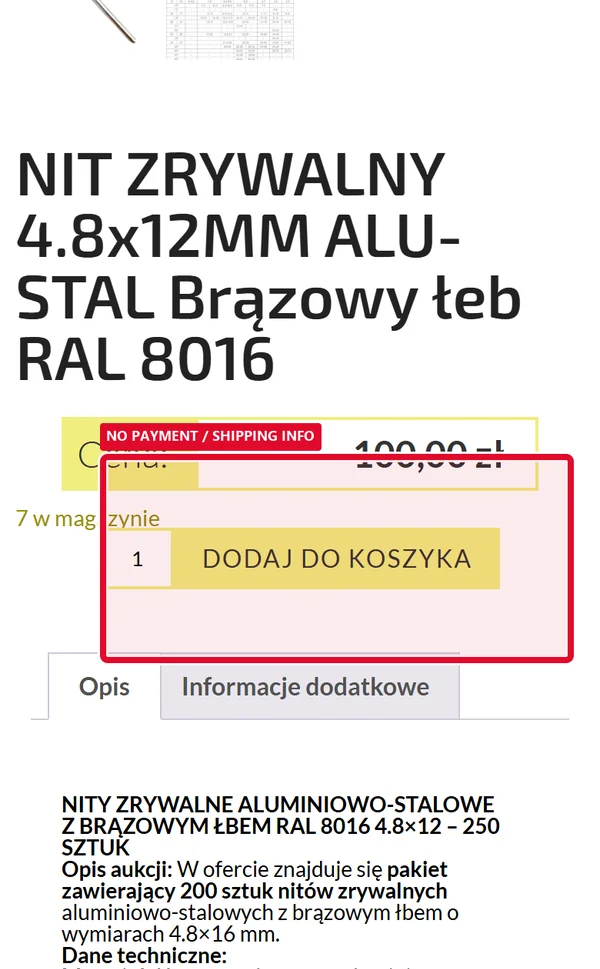
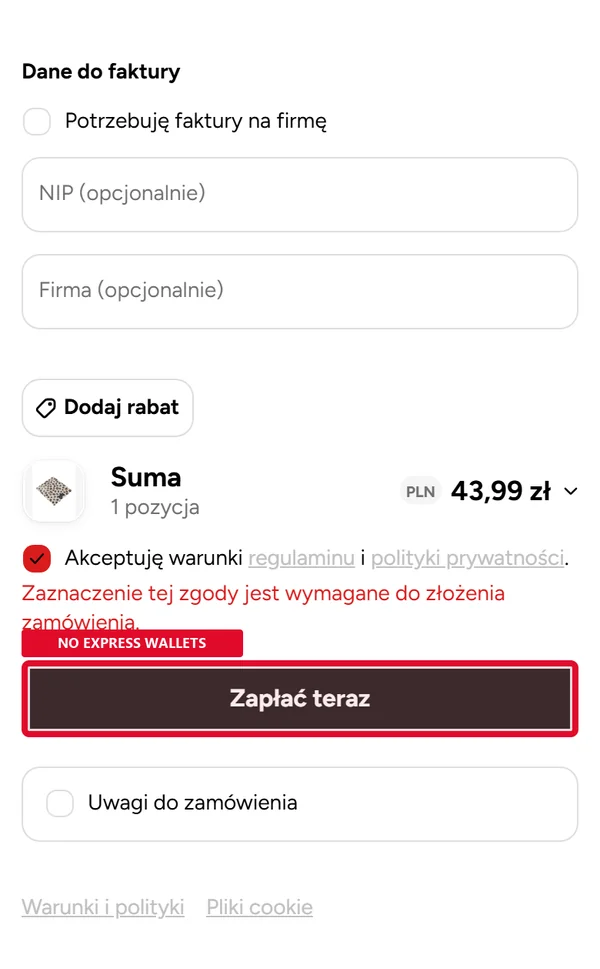
Payment & delivery UX from Product Page to parcel locker map
1. Surface shipping cost and 3-4 payment badges on the PDP
Place a compact, scannable line directly below Add-to-Cart showing starting delivery cost, free-shipping threshold, realistic dispatch time, and 3 to 4 recognizable payment icons. Avoid a cluttered wall of 15 bank logos.
2. Order payment methods by real share, not plugin defaults
Sort checkout methods by actual usage per market and device. Put native mobile wallets and the dominant local instant rail at the top, cards right below, BNPL next, and legacy bank transfers or cash-on-delivery last.
3. Audit parcel locker maps and failed payment recovery on 390 px screens
Parcel pickup maps (such as InPost Paczkomaty in Poland or DPD/DHL lockers across Europe) frequently break on mobile with double scrollbars and off-screen confirm buttons. Always verify what happens when a buyer cancels mid-gateway: returning to an empty cart is an instant lost order.
Analytics warning: external payment gateway redirects without GA4 Referral Exclusion hijack transaction attribution from Google Ads and Meta Ads.
See the full checklist in Duplicate or Missing Transactions in GA4.Where to surface payments and delivery across the funnel
Remove doubt before the click
Show starting shipping fee, dispatch cut-off time, and 3-4 compact payment badges right below Add-to-Cart.
Clarify total & offer express path
Show remaining amount to free shipping, keep promo code collapsed, and offer one-click express wallets where supported.
Rank by real payment share
Put top local rails and mobile wallets first; pair parcel locker pickers with postcode search and GPS fallback.
7-point payment & delivery QA checklist
- Starting delivery cost, free-shipping threshold, and key payment badges appear on the PDP before Add-to-Cart.
- The #1 local payment rail sits at the top of checkout, not buried inside a generic gateway label.
- Apple Pay actually renders in iOS Safari and Google Pay renders in Android Chrome.
- Parcel locker / pickup map search works cleanly on a 390 px mobile viewport without clipping the confirm CTA.
- Cancelling a gateway payment returns the buyer to an intact cart with one-click retry.
- All payment gateway domains are added to GA4 Referral Exclusions.
- BNPL fees and free-shipping thresholds are modeled against post-return unit margin.
Run a full interactive check with our Cart & Checkout Audit Tool, and pair it with Abandoned Cart Blockers and One-Step Checkout in Practice.
PUSH-CRO Scanner
Check your store in 2 minutes for mobile UX blockers, PDP trust gaps, WCAG issues, and GA4 configuration errors.
Store Diagnosis + 1h 1:1 Call
Manual mobile and desktop journey review, a 15+ page PDF report with annotated screenshots, and a 1-hour live call.
Full UX/CRO & GA4 Audit
Start (€890), Architecture & CRO (€2,100), or 360° Audit (€3,950) with developer-ready specs and QA verification.
Contact
Book a free 15-minute consultation.
Fill in the form. Dawid Śliwiński (Co-founder of PUSH) will analyse your store and get back to you within 24 hours with an actionable plan.

What you get within 24 hours
- An initial store review by Dawid Śliwiński (no sales reps).
- 2-3 concrete conversion blockers spotted on your live purchase journey.
- A tailored next-step recommendation matched to your store's scale (audit, fixed sprint or retainer).